Generative Video Compiler
Taken Pictures was made by a program I couldn’t read. In 2026, building this website, I finally understand what it actually did.
1.0The method
A file cabinet with three drawers. Each drawer holds 360 frames, filled with containers — contiguous runs of 10 to 75 frames lifted from a random point in a library of image sequences extracted from found footage, spilling into another folder when a run comes up short. Every container carries a random blend mode and a random opacity. The three drawers are composited against each other, the blended frame is read as noise and resolved back into imagery by diffusion, and the result is cross-dissolved to double the frame count.
I don’t write Python. Still, to this day, don’t. When describing what I was envisioning in words failed, I drew it instead in Illustrator. The drawing is what finally made the system legible to a machine — and the script that came back is what made the film.
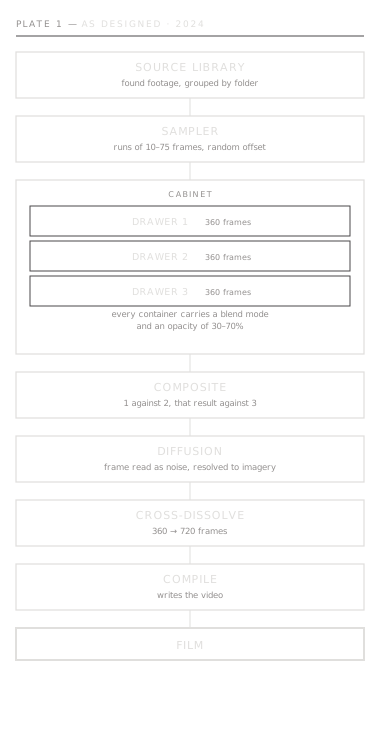
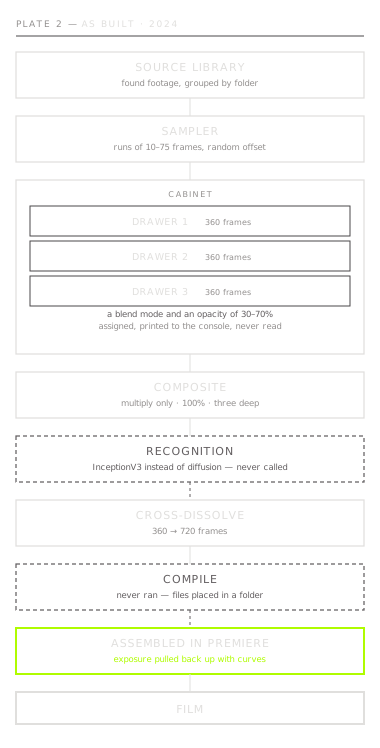
Figure 1The same skeleton, twice. Dashed nodes were written and never executed; struck text was assigned and never applied. The lime step is the one that isn’t in the design document at all — it happened in the edit.
2.0What was built
Four things the script was designed (or asked) to do, it didn’t. The blend mode and the opacity were both chosen at random, printed to the console, and never read again — everything composited with multiply at full strength.
Diffusion was never written at all. What came back instead was an InceptionV3 recognition pass — a different technology answering a different question — and it didn’t run either: the model loaded, every frame was preprocessed for it, and predict() was never called. A model loaded and discarded, 360 times a run.
3.0Why everything came out dark
Multiply always darkens. Run three layers deep with no opacity to soften it, and the exposure collapses.
As I’ve come to learn, what the original, utilized script produced was roughly four times darker than intended. For the entire life of the project I pulled every export back up with curves in Premiere — correcting, without knowing it, for two lines of code that never ran. I couldn’t see what the script had produced until I brought the exposure back up.
I didn’t learn any of this until Claude read the code back while we were building this page — two years after the film was finished and shown.
4.0As designed, as built
When a building differs from its drawings nobody calls it a failure. They issue as-built drawings — a record of what was actually constructed, filed alongside what was planned. Both documents stay. Neither one is the mistake.
Taken Pictures is as-built. The film is real and finished — but the system in the design document is not the system that made it, and the difference between them is visible to me now, in retrospect, in every frame.
5.0The 2026 revision
There is now a second script that does what the first one was supposed to. It applies the blend modes and the opacities, drops the recognition pass entirely, takes a seed so a run can be repeated, and compiles the video itself. Both versions are published together, because they make different images, and the 2024 one is the only reason the film turned out the way it did.